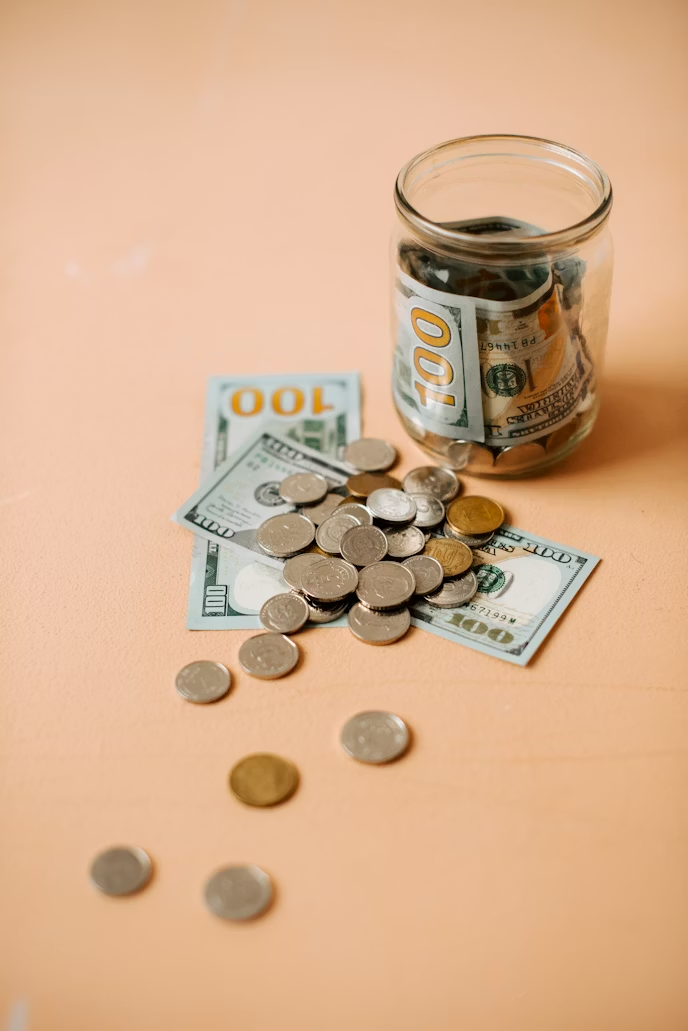
The Wake-Up Call: My Traditional Bank Was Stealing From Me
For years, I kept $100,000 in a traditional savings account at a big-name bank, earning a whopping 0.01% interest. That's $10 per year. Meanwhile, I could have been earning 4-5% in a high-yield savings account—$4,000 to $5,000 per year on the same money.
That realization cost me tens of thousands of dollars in missed earnings. In this guide, I'll show you exactly how to avoid my mistake and start earning real money on your cash savings in 2025.
What Is a High-Yield Savings Account?
A high-yield savings account (HYSA) is a savings account that pays significantly higher interest rates than traditional brick-and-mortar banks. While major banks like Chase or Bank of America pay 0.01-0.05% APY, high-yield accounts currently offer 4-5% APY.
The math that matters:
- $50,000 at 0.01% = $5 per year in interest
- $50,000 at 4.5% = $2,250 per year in interest
- Difference: $2,245 extra per year for doing absolutely nothing different
Key features:
- FDIC insured up to $250,000 (same safety as traditional banks)
- No risk to principal—your money doesn't go down
- Liquid—withdraw anytime without penalties (unlike CDs)
- Interest compounds daily or monthly
- Typically offered by online banks with lower overhead costs
Best High-Yield Savings Accounts in 2025
1. Marcus by Goldman Sachs
Current APY: 4.40%
Minimum deposit: $0
Monthly fees: None
Pros:
- Backed by Goldman Sachs (major bank credibility)
- Excellent customer service
- Easy-to-use mobile app
- No maintenance fees or minimum balance
Cons:
- No physical branches (online only)
- Limited account types (just savings and CDs)
2. Ally Bank
Current APY: 4.35%
Minimum deposit: $0
Monthly fees: None
Pros:
- Full-service online bank (checking, savings, investing)
- 24/7 customer support
- ATM fee reimbursement
- Buckets feature for goal-based savings
Cons:
- Rates sometimes lag competitors by 0.05-0.10%
- No physical branches
3. American Express Personal Savings
Current APY: 4.35%
Minimum deposit: $0
Monthly fees: None
Pros:
- Trusted brand with strong financial backing
- Simple, straightforward interface
- Quick transfers to/from external accounts
- Excellent security features
Cons:
- Limited account options
- No checking account option
4. CIT Bank Platinum Savings
Current APY: 5.05% (with $5,000+ balance)
Minimum deposit: $100
Monthly fees: None
Pros:
- Highest rates available for qualified balances
- Strong mobile app
- Multiple savings account options
Cons:
- Lower rate (0.25%) if balance falls below $5,000
- Less well-known brand
5. UFB Direct
Current APY: 5.25%
Minimum deposit: $0
Monthly fees: None
Pros:
- Consistently highest rates in industry
- No minimum balance requirements
- Simple account opening process
Cons:
- Smaller bank with less brand recognition
- Limited additional account options
- Customer service hours not 24/7
How Much Can You Really Earn? Real Examples
Emergency Fund: $20,000
- Traditional bank (0.01%): $2/year
- High-yield account (4.5%): $900/year
- Difference: $898 extra annually
House Down Payment Fund: $80,000
- Traditional bank (0.01%): $8/year
- High-yield account (4.5%): $3,600/year
- Difference: $3,592 extra annually
Business Reserve: $150,000
- Traditional bank (0.01%): $15/year
- High-yield account (4.5%): $6,750/year
- Difference: $6,735 extra annually
My personal result: I moved $93,000 (emergency fund + house savings) to a HYSA earning 4.5%. First year earnings: $4,185. Previous year at traditional bank: $9.30.
High-Yield Savings vs. Other Safe Options
HYSA vs. Money Market Accounts
Money Market Accounts:
- Similar rates to HYSA (3.5-4.5%)
- Often include check-writing privileges
- May require higher minimum balances ($2,500-$10,000)
- Sometimes charge monthly fees
Winner: HYSA for most people due to no minimums and no fees
HYSA vs. Certificates of Deposit (CDs)
CDs:
- Slightly higher rates (4.5-5.5%) for locking money up
- Terms from 3 months to 5 years
- Early withdrawal penalties (3-12 months of interest)
- Rate locked in regardless of market changes
Winner: HYSA for emergency funds (need liquidity); CDs for money you won't need for 1+ years
HYSA vs. Treasury Bills
Treasury Bills:
- Similar rates to HYSA (4.5-5.3% depending on term)
- Backed by U.S. government (safest possible investment)
- State tax-free interest (advantage if you live in high-tax state)
- Must buy in $100 increments through TreasuryDirect.gov
- Less liquid (need to hold to maturity or sell on secondary market)
Winner: HYSA for emergency funds; T-Bills for large balances ($100,000+) in high-tax states
Optimization Strategies: Maximizing Your Earnings
Strategy #1: The Rate-Chasing Approach
Some savers maintain accounts at 2-3 banks and move money to whichever offers the highest rate each quarter.
Potential benefit: Earn 0.10-0.25% more annually
Time cost: 2-4 hours per year managing transfers
Worth it? Only for balances over $50,000+
My take: I don't rate-chase for differences under 0.25%. Not worth the mental energy for an extra $50-100/year on typical balances.
Strategy #2: The Ladder Approach
Split your savings across HYSAs and short-term CDs to balance liquidity and higher rates.
Example with $50,000:
- $15,000 in HYSA (4.5%) for immediate emergencies
- $15,000 in 3-month CD (4.8%)
- $10,000 in 6-month CD (5.0%)
- $10,000 in 12-month CD (5.3%)
As CDs mature, roll them into new CDs or keep in HYSA depending on your needs.
Result: Earn 0.3-0.5% more than HYSA alone while maintaining decent liquidity
Strategy #3: The Multi-Bank FDIC Maximization
FDIC insurance covers $250,000 per depositor, per institution. If you have more than $250,000 in savings, spread it across multiple banks.
Example with $600,000:
- $250,000 at Marcus (fully insured)
- $250,000 at Ally (fully insured)
- $100,000 at American Express (fully insured)
All $600,000 is now FDIC protected instead of risking $350,000 above the limit.
Strategy #4: The Automated Sweep System
Keep checking account at zero-fee bank, automatically sweep excess over a threshold to HYSA.
Example setup:
- Maintain $2,000 minimum in checking for bills
- Set up rule: any balance over $2,500 automatically transfers to HYSA weekly
- Result: Every extra dollar earns 4.5% instead of 0.01%
Many banks offer this feature; alternatively, set up recurring transfers manually.
Common Mistakes That Cost You Money
Mistake #1: Keeping too much in checking
- Average American keeps $10,000+ in checking earning nothing
- Keep only 1-2 months expenses in checking, rest in HYSA
- Cost of this mistake on $10,000: $450/year in lost interest
Mistake #2: Not comparing rates annually
- Rates change constantly—your bank might have fallen behind
- Set calendar reminder to check rates every 6 months
- If your rate is 0.50%+ below top offers, consider switching
Mistake #3: Paying fees on savings accounts
- Never pay monthly maintenance fees on a savings account
- Plenty of excellent HYSAs charge zero fees
- $10/month fee = $120/year, wiping out interest on $2,700 balance at 4.5%
Mistake #4: Sacrificing FDIC insurance for slightly higher rates
- Some fintech apps offer 5-6% but aren't FDIC insured
- Extra 1% isn't worth risking your principal
- Stick with FDIC-insured banks only for your savings
Mistake #5: Treating HYSA as investment account
- 4-5% is great for cash, but won't build long-term wealth
- After inflation, real return is 1-2%
- Use HYSA for emergency fund and short-term goals only
- Long-term wealth building requires stocks/real estate (higher returns)
Tax Considerations: What You Need to Know
Interest is taxable income
- All interest from HYSAs is taxed as ordinary income
- You'll receive Form 1099-INT if you earn $10+ in interest
- Report on your tax return even if under $10
Tax impact example:
- $100,000 balance earning 4.5% = $4,500 interest
- If you're in 24% tax bracket: $1,080 goes to taxes
- After-tax return: $3,420 or 3.42% effective rate
Tax optimization strategies:
- If in low tax bracket (12% or less), HYSA tax impact is minimal
- High earners (32%+ bracket) might prefer tax-free municipal bonds for similar after-tax returns
- Consider Treasury bills if in high state-tax state (interest is state tax-free)
How to Open Your First High-Yield Savings Account
Step 1: Research and choose (30 minutes)
- Compare top 3-5 banks from this guide
- Check current rates on bank websites (they change monthly)
- Read reviews on Reddit r/personalfinance or Bankrate
Step 2: Gather required information (10 minutes)
- Social Security number or ITIN
- Driver's license or state ID
- Home address
- Email and phone number
- Employment information (some banks ask)
Step 3: Open account online (15 minutes)
- Application takes 10-15 minutes
- Instant approval in most cases
- May need to upload ID photo or verify identity
Step 4: Fund your account (3-5 business days)
- Link existing checking account for ACH transfer
- Some banks allow initial deposit by check/wire
- Transfers typically take 2-5 business days to complete
Step 5: Set up automatic transfers (optional but recommended)
- Schedule monthly transfers from checking to savings
- Automate the "pay yourself first" principle
When HYSAs Make Sense (And When They Don't)
Perfect for HYSAs:
- Emergency fund: 3-6 months of expenses earning interest while staying accessible
- House down payment fund: Money you'll need in 1-3 years shouldn't be in stocks
- Large upcoming purchases: Car, wedding, major vacation in next 12-24 months
- Business operating reserve: 3-6 months of business expenses
- Tax payment savings: Quarterly estimated taxes for self-employed
Wrong for HYSAs:
- Retirement savings: Too conservative, won't keep up with inflation long-term
- College fund: 15+ year timeline should be in stock/bond mix
- Daily spending money: Keep 1-2 months in checking for convenience
- Get-rich investments: 4.5% won't build wealth, use for safety/liquidity only
The Future of High-Yield Savings Rates
Interest rates on HYSAs track the Federal Reserve's benchmark rate. Understanding this relationship helps you anticipate rate changes:
When Fed raises rates: HYSA rates go up (usually within 1-2 months)
When Fed cuts rates: HYSA rates go down (usually within 1-2 months)
2025 outlook: With inflation moderating, the Fed may cut rates 1-2 times in 2025. Expect HYSA rates to drift down from 4.5% to 3.5-4% range by end of year. Still dramatically better than traditional banks.
Strategy: If rates are high when you read this, consider locking some money in 12-month CDs at today's rates before they fall.
Frequently Asked Questions
Q: Are high-yield savings accounts safe?
A: Yes, if FDIC insured. Same government backing as traditional banks up to $250,000 per depositor.
Q: Why don't traditional banks offer high rates?
A: They have expensive physical branches and don't need to compete aggressively for deposits. Online banks have lower costs and pass savings to customers.
Q: Can rates change after I open an account?
A: Yes, HYSA rates are variable and change monthly. But so do rates at all banks—online banks still pay far more than traditional banks.
Q: How long does it take to access my money?
A: Transfers to external bank accounts take 1-3 business days. Plan accordingly for emergencies.
Q: Is there a limit to how much I can deposit?
A: No deposit limits, but FDIC only insures up to $250,000 per account type per bank.
Q: Can I lose money in a high-yield savings account?
A: No. Your principal never decreases. Only the interest rate can change.
My Exact HYSA Setup (And Why)
Here's my current allocation as of 2025:
Marcus HYSA: $55,000 (Emergency Fund)
- 6 months of living expenses
- Currently earning 4.40% = $2,420/year
- Peace of mind + earnings
Ally Bank HYSA: $38,000 (House Savings)
- Down payment fund for next 18-24 months
- Currently earning 4.35% = $1,653/year
- Using "buckets" feature to separate: down payment, closing costs, moving expenses
12-month CD at CIT: $25,000
- Locked at 5.3% = $1,325/year
- Money I definitely won't need for a year
- Will reassess when it matures
Total annual interest: $5,398
Previous annual interest (traditional bank): $11.80
Improvement: $5,386.20/year for zero extra risk
Action Steps: What to Do Right Now
Beginner (Have $1,000+ in savings):
- Check your current savings rate (it's probably under 0.10%)
- Open Marcus or Ally HYSA this week
- Transfer all but 1-2 months expenses from checking to HYSA
- Set up automatic monthly transfers
Intermediate (Have $10,000+ in savings):
- Compare top 5 HYSA rates and choose best fit
- Move emergency fund to HYSA immediately
- Consider CD ladder for money you won't need for 6-12+ months
- Set calendar reminder to review rates in 6 months
Advanced (Have $100,000+ in savings):
- Split across 2-3 banks for FDIC coverage
- Create CD ladder for portion of funds
- Compare HYSA vs Treasury bills for tax optimization
- Consider money market funds at brokerages for even higher rates
Conclusion: The Easiest Money You'll Ever Make
Moving your savings from a traditional bank to a high-yield account is the lowest-effort, highest-impact financial decision you can make. No risk, no complexity, no ongoing management—just thousands of extra dollars per year.
I've made plenty of financial mistakes over the years. Keeping money in a 0.01% account for years ranks among my costliest. It taught me an important lesson: inertia is expensive.
The difference between 0.01% and 4.50% on $50,000 is $2,245 per year. Over 10 years, that's $22,450 in interest you either earn or leave on the table. For one hour of effort to switch banks.
Don't repeat my mistake. Open a high-yield savings account this week. Your future self will thank you.