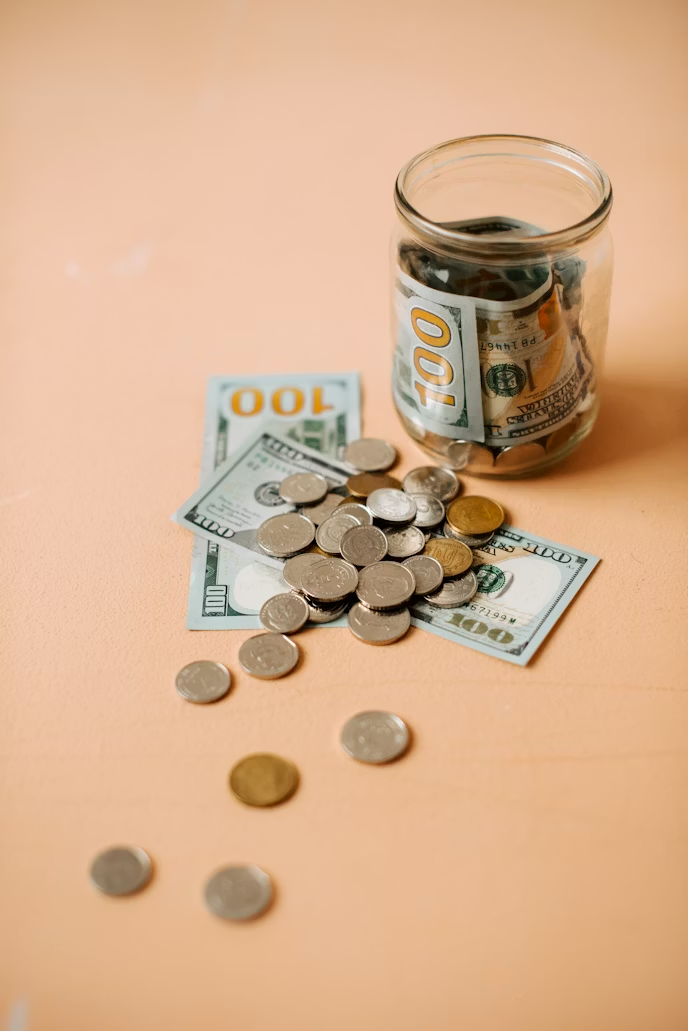
Why $10,000 Changes Everything
Ten thousand dollars isn't just a number. It's the difference between living paycheck-to-paycheck and having options. It's the emergency fund that lets you quit a toxic job. It's the down payment on your future. It's confidence in your bank account.
Most people think saving $10K requires a six-figure salary. Wrong. It requires a system, discipline, and twelve months of focused execution. Here's your blueprint.
The Math: Breaking Down $10,000
$10,000 ÷ 12 months = $833.33/month
$833.33 ÷ 4.33 weeks = $192.44/week
$192.44 ÷ 7 days = $27.49/day
Your mission: Find a way to save, earn, or not spend $27.49 every single day for one year.
Still sound impossible? Keep reading.
Phase 1: Months 1-3 (Foundation Building)
Goal: Save your first $2,500
Month 1: The Audit ($750 target)
You can't save what you don't know you're spending. Week one is pure data collection.
Action steps:
- Download Mint or YNAB (You Need A Budget)
- Link all accounts and credit cards
- Categorize every transaction from the last 90 days
- Find the leaks (most people discover $200-400 in forgotten subscriptions and mindless spending)
Quick wins for Month 1:
- Cancel unused subscriptions: +$80/month
- Switch to cheaper phone plan: +$40/month
- Meal prep lunches instead of buying: +$150/month
- Sell stuff you don't use (Facebook Marketplace, OfferUp): +$300 one-time
Month 1 savings: $570 from cuts + $300 from selling stuff = $870 ✓
Month 2: Automate Everything ($850 target)
Willpower fails. Automation succeeds.
Set up these automations:
- The day after payday: Auto-transfer $200 to separate savings account
- Every Friday: Auto-transfer $50 to savings (weekly momentum feels good)
- Round-up apps (Acorns, Qapital): Round purchases to nearest dollar, save difference
Add one income stream:
- Drive for Uber/Lyft on weekend nights: +$400/month
- OR freelance on Fiverr/Upwork: +$300-500/month
- OR deliver for DoorDash/Instacart: +$350/month
Month 2 savings: $450 automated + $400 side hustle = $850 ✓
Month 3: The 30-Day No-Spend Challenge ($900 target)
One month of extreme discipline to build momentum.
The rules:
- Only spend on: Rent, utilities, groceries, gas, required bills
- Everything else is banned: Restaurants, bars, shopping, entertainment, impulse purchases
- Entertainment must be free: Parks, library, YouTube, hiking, game nights at home
Why this works: Breaking consumption habits creates lasting behavior change. Most people save $400-600 in one month doing this.
Month 3 savings: $500 from challenge + $400 from side hustle = $900 ✓
End of Phase 1: $2,620 saved (26% of goal complete)
Phase 2: Months 4-8 (Acceleration)
Goal: Save $4,165 more (Total: $6,785)
You've proven you can do this. Now scale what's working and eliminate what isn't.
Month 4-8 Strategy:
1. The Percentage Game
Instead of fixed amounts, save percentages based on income sources:
- Save 30% of primary paycheck
- Save 80% of side hustle income
- Save 100% of windfalls (tax refunds, bonuses, gifts)
2. Optimize the Big Three Expenses
Most people waste money on housing, transportation, and food. Attack these.
Housing hacks:
- Get a roommate or rent out spare room: +$400-800/month
- House sit or pet sit for free housing: +$1,200/month saved
- Negotiate rent renewal (works 40% of the time): +$50-100/month
Transportation hacks:
- Sell car, use bike + rideshare: +$350/month (gas, insurance, maintenance)
- Refinance auto loan to lower rate: +$40-80/month
- Carpool to work: +$60/month in gas
Food hacks:
- Meal prep Sundays (bulk cook for week): Saves $200/month vs eating out
- Grocery shop with list only: Saves $80/month in impulse buys
- Use Ibotta and Fetch Rewards apps: Saves $30-50/month
3. The Income Boost
Months 4-8 are when you level up your earning power.
Strategies that work:
- Ask for raise at 6-month mark (prepare documented wins): +$200-400/month
- Take on overtime shifts if hourly: +$300-600/month
- Flip items from thrift stores on eBay: +$200-500/month
- Rent out parking space or storage: +$100-200/month
Monthly savings Months 4-8: $833/month × 5 months = $4,165
End of Phase 2: $6,785 total saved (68% of goal complete)
Phase 3: Months 9-12 (The Final Push)
Goal: Save final $3,215 and cross the finish line
This is where mental fatigue hits. You're so close, but the discipline feels harder than ever. Here's how to finish strong.
Month 9: The Motivation Refresh
Revisit why you started. Update your "why" if it's changed.
Visual motivation tactics:
- Print a $10,000 bill image and cross off every $500 saved
- Create vision board of what $10K enables (house, trip, freedom, security)
- Calculate the "fuck you money" power (months of expenses this covers)
Month 9 action: Save $833 + treat yourself to $100 celebration for hitting $7,500 milestone
Month 10: The Tax Refund/Bonus Windfall
If you get a tax refund or year-end bonus, this is your shortcut to the finish line.
Windfall allocation:
- 80% straight to savings goal
- 20% to enjoy guilt-free
A $2,000 tax refund means $1,600 toward goal. You're now at $9,100+. One month left.
Month 11-12: The Sprint Finish
Go all in. Two months of maximum effort to cross the line.
Aggressive tactics:
- Pick up every extra shift available
- Run a "garage sale" selling anything non-essential
- Offer premium services (house cleaning, moving help, handyman) on weekends
- Cut discretionary spending to zero
Final two months target: $450/month from existing systems + $450/month from hustle = $900/month × 2 = $1,800
End of Phase 3: $10,000+ saved ✓
The Real Numbers: Sample Budget That Works
Starting salary: $45,000/year ($2,885/month after tax)
Fixed expenses:
- Rent (with roommate): $650
- Utilities: $80
- Car payment: $280
- Insurance: $120
- Phone: $35
- Gas: $100
- Total fixed: $1,265
Variable expenses:
- Groceries: $250
- Eating out (limited): $80
- Entertainment: $50
- Misc/emergencies: $100
- Total variable: $480
Available for savings from salary: $2,885 - $1,745 = $1,140
Side hustle income: $400/month
Total available: $1,540/month
Target savings: $833/month
Cushion: $707/month
This budget works even on a modest salary with room to spare.
When Life Happens: The Contingency Plan
You will have setbacks. Car repairs. Medical bills. Life emergencies. Here's how to handle them without derailing your goal.
The 50% Rule:
If you have an unexpected expense, save 50% of your normal amount that month and use the other 50% to cover the emergency.
Example: $600 car repair hits in Month 5. Instead of saving $833, save $416. Use the other $417 toward the repair. Pay remaining $183 from emergency buffer or next month.
The Make-Up Month:
If you fall behind, designate one month (Month 11 or 12) as a "catch-up sprint" where you go extreme to make up the shortfall.
What NOT to Do (Common Mistakes)
Mistake #1: Keeping savings in checking
You'll spend it. Open a separate high-yield savings account (Ally, Marcus, CIT Bank). Make it slightly inconvenient to access.
Mistake #2: Going too extreme too fast
Cutting every joy from your life leads to burnout and binge spending. Keep $100-150/month for guilt-free fun.
Mistake #3: Not tracking progress
What gets measured gets managed. Check your balance weekly. Celebrate every $1,000 milestone.
Mistake #4: Lifestyle inflation from side hustle
Extra income isn't permission to spend more. Save 80%+ of side hustle earnings.
Mistake #5: Giving up after one bad month
One month below target doesn't mean failure. Adjust and keep going. Progress isn't linear.
The Snowball Effect: What Happens After $10K
Once you hit $10,000, the discipline you built makes the next $10K easier. Here's what changes:
- You've proven you can live on less than you earn
- Side hustles are established and generating consistent income
- Spending habits are fundamentally rewired
- Compound interest starts working (invest the next $10K)
Month 13-24 possibilities:
- Keep $10K as emergency fund (peace of mind achieved)
- Invest $833/month in index funds (becomes $120K in 10 years)
- Save for house down payment
- Pay off high-interest debt
- Quit job you hate and have runway to find better one
Your First Week Action Plan
Day 1: Open high-yield savings account specifically for this goal
Day 2: Track every dollar you spend today (start awareness)
Day 3: List all subscriptions and cancel unused ones
Day 4: Calculate your exact monthly income after taxes
Day 5: Create budget showing where money goes now vs. where it should go
Day 6: Research one side hustle you could start this month
Day 7: Make first deposit into your $10K savings account (even if it's just $50)
The Mindset Shift That Makes This Possible
Saving $10,000 isn't about deprivation. It's about priorities.
Every dollar you spend is a choice. You're choosing between:
- This latte OR 0.3% closer to financial security
- These new shoes OR one more day of freedom
- Going out tonight OR retiring 2 weeks earlier
When you internalize that spending is opportunity cost, saying no gets easier.
Twelve months from now, you'll either have $10,000 in the bank or wish you'd started today. The year will pass either way.
Choose the version of yourself that finishes what they start.